QNX 8.0 Tool 'Telltale' Detects False Instrument Reads in Real-Time
Open-source monitor verifies automotive display accuracy by reading back pixels, addressing critical safety gaps in renderer processes
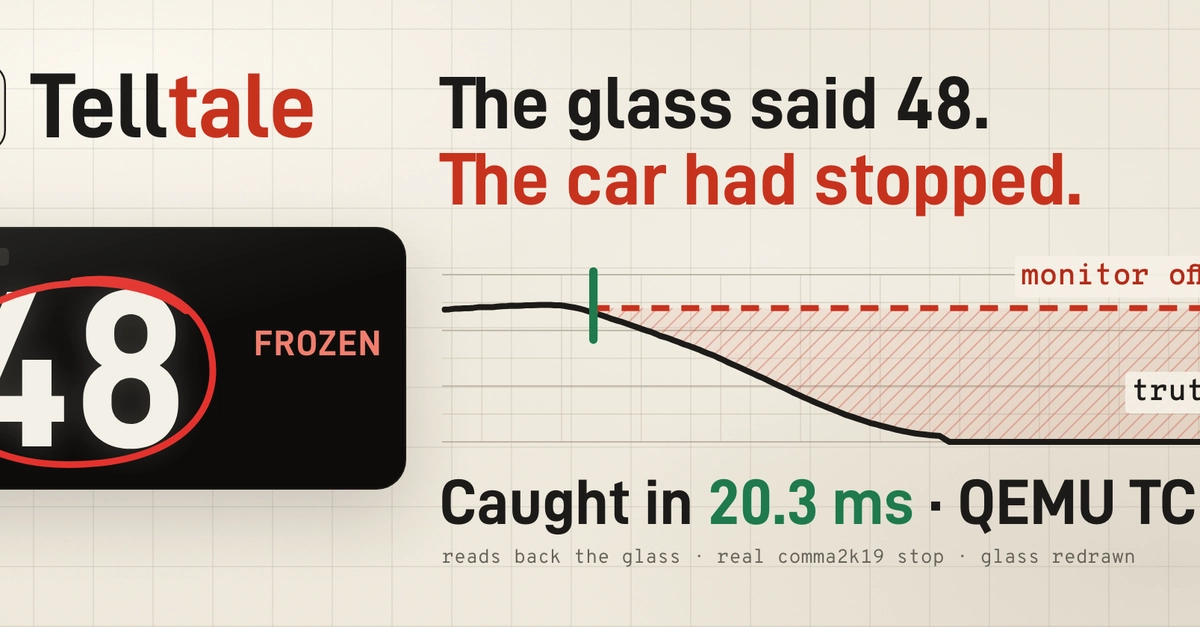
CANADA — A new open-source tool called Telltale addresses a critical gap in automotive safety systems: verifying whether instrument cluster displays accurately reflect real vehicle data. Developed for QNX 8.0, the solution reads back actual pixels composed by QNX Screen to detect when renderers freeze while continuing to report false 'liveness' signals—a scenario where speedometers or warning lights might display incorrect information despite passing conventional health checks.
The system works by independently decoding displayed digits and indicators from screen pixels, comparing them against ground truth vehicle state data. In benchmark tests using real driving data from the comma2k19 dataset, Telltale successfully detected all 200 injected faults across four failure classes, though some detection times slightly exceeded targets for certain fault types. The tool prioritizes safety by displaying correct information before attempting to restart faulty renderers.
Telltale's architecture leverages QNX's native capabilities, with vehicle state exposed through standard /dev interfaces that both applications and humans can query. The monitor itself provides its status through similar interfaces at /dev/telltale, maintaining the system's transparency and debuggability. Notably, the solution avoids machine learning, using deterministic glyph decoding against a known atlas for consistent verification results.
While currently uncertified and tested only in QEMU emulation, the project demonstrates an important safety principle for automotive software: conventional process monitoring can't detect all failure modes affecting displayed information. The open-source release includes detailed benchmarks, test suites, and even preserved failing test runs that led to improvements—a transparency approach that could influence safety-critical development practices.
Reported with files from DEV Community.
 News
Ollama Local LLM Gains Monitoring Tools for Production Use
Developers adopting Ollama for local LLM deployment now have guidance on monitoring metrics, logs, and traces as usage scales beyond personal projects.
 News
GitHub Merge Queue Test Shows Tradeoffs for AI Coding Agent Workflows
Benchmark reveals merge queues eliminate rejected pushes but add latency when coordinating multiple AI agents on a single codebase
 News
Developers Can Improve Online Presence with Person Schema and Wikidata
A software developer shares practical steps to help Google connect disparate online profiles into a unified knowledge panel.
 News
How to Scrape SmartRecruiters Jobs Using Python and Public API
Learn how to access job postings from SmartRecruiters' public API using Python, with no API key required, for building niche job boards or tracking competitor hiring.